 Vinyl Express Q-Series Cutter
November 26, 2008
The Vinyl Express Q-Series is a cut only device, and is only available if the special registration code, CUTTING, is enabled.
Important Note: Automatic registration using the Rip Detect setting is only available if your Vinyl Express was purchased with the optional ARMS auto-alignment system.
Initial Software and Cutter Setup
- SoftRIP Registration Mark Setup: Wasatch SoftRIP can print five types of marks for use with the Vinyl Express cutter. These marks are selected from the Cutting Registration Marks button inside the 'Setup - Print Unit' window. Select either the Vinyl Express Type 1, Vinyl Express Type 2 marks or the Vinyl Express 1/2 Inch Interval Cut Marks, if you intend to use the RIP Detect registration method (see the "RIP Detect Registration" section below). After selecting Vinyl Express Type 1 or Vinyl Express Type 2 marks, a separate window will open to allow you to choose the size of the cutting marks. Refer to the Vinyl Express Cutting Marks help for more information on this.
Use the 1/2 Inch Register or 1/4 Inch Register marks if you intend to align your job manually (see the "Manual Registration" section below).
Note: When printing any of these marks, you should print with 1" or greater left and right margins, and at least a 2" or greater top and bottom margins. This ensures that the cutter has enough room to properly detect the registration marks.
- Connection: Choose the physical connection from the 'Setup - Print Unit' window.
- USB: When you first plug the cutter into a USB port you will be prompted for a USB driver. Install the Vinyl Express driver provided with the cutter. Once complete, the Vinyl Express will show up in the physical connection list on the print->setup screen.
- COM: Select the COM port to which the serial cable is connected.
- LPT: Wasatch SoftRIP does not support the parallel interface for this device.
Note: There are two methods to have the cutter detect registration marks. Go to the properties page (Print->Setup->Edit->Properties) to set up which mode to use.
- The first (Rip Detect) lets the registration come from the RIP.
- The second method (Manual Detect) is a manual method.
Device-Specific Instructions for Print now, Cut Later (RIP Detect Registration)
Note: The print should have been printed with Vinyl Express Type 1, Vinyl Express Type 2 or Vinyl Express 1/2" Interval Register marks. These marks can be selected from the Cutting Registration Marks menu on the Print/Setup screen prior to printing.
Loading the media:
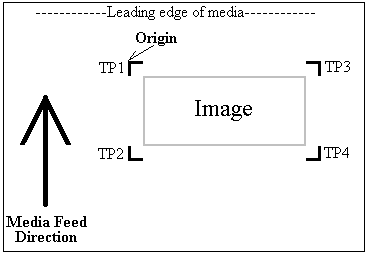
- As the print comes off the printer, note the edge that is to the lower right corner of the print. That corner will be referred to hereafter as the origin (TP1) of the print (see illustration above).
- Insert the media in the same direction as the media originally came out of the printer. Since the cutter cannot cut any media beyond the pinch roller nearest the control panel or the pinch roller furthest from the control panel, align the media so that the pinch rollers are outside of the cutting area.
- After setting the pinch rollers, press Sheet or Roll to choose paper. Align the knife in the open area bounded by the first mark (TP1) as shown to the right. Press Origin.
- In SoftRIP, go into properties (Print->Setup->Edit->Properties) and choose RIP Detect
- The cutter is now ready for the cut path to be sent from the queue. See the user manual for further assistance.
Device-Specific Instructions for Print now, Cut Later (Manual Registration)
Note: The print should have been printed with 1/4" or 1/2" Register marks (Not Vinyl Express marks). Select these marks from the Cutting Registration Marks menu on the Print/Setup screen.
Loading the media:
- As the print comes off the printer, note the edge that is to the lower right corner of the print. That corner will be referred to hereafter as the origin (TP1) of the print (see illustration above).
- Insert the media in the same direction as the media originally came out of the printer.
Note: Since the cutter cannot cut any media beyond the pinch roller nearest the control panel or the pinch roller furthest from the control panel, align the media so that the pinch rollers are outside of the cutting area.
- After setting the pinch rollers, press Sheet or Roll to set paper type.
- Align the knife with mark #1. Press Origin.
- In SoftRIP, go into properties (Print->Setup->Edit->Properties) and choose Rip Detect
- The cutter is now ready for the cut path to be sent from the queue.
- When the path is sent, an information screen will ask you to align point #1
- Use arrow keys to make sure knife is centered on the mark and press Enter
- The knife will move to next point. Use arrow keys to adjust and press Enter
- The knife will move to next point. Use arrow keys to adjust and press Enter
- The knife will move to the final point. Use arrow keys to adjust and press Enter
- Cutting will now proceed.
Device-Specific Instructions for Cut Only
Loading the media:
- Insert the media in the cutter and align the media so that the pinch rollers are outside of the cutting area.
- After setting the pinch rollers, press Sheet or Roll to choose paper.
- Use arrow keys to place the knife over the desired starting point.
- Press Origin
- The cutter is now ready for the cut path to be sent from the queue.
Interval Between Cut Marks
If you select Vinyl Express 1/2 Inch Interval Cut Marks from the Cutting Registration Marks menu in Wasatch SoftRIP, registration marks will be printed at regular intervals down the edges of any print layout. (This feature only works with layouts and with the print spooler, never with immediate print of a single page.)
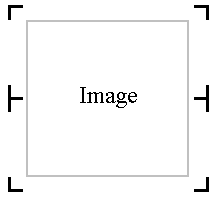
When you make this selection, you'll be presented with the following control.

If the length of the print equals or is greater than the Maximum Cutting Mark Interval then interval marks will be created at a regular subdivision spacing. This means that the interval marks would be half of the print length, as would happen if you set a 24 inch interval and were printing 24.1 inches, as shown above.
For example:
- When printing an image 24" long, with the maximum cutting mark interval of 24", two marks are placed along the edge (at the corners).
- When printing an image 25" long, with the maximum cutting mark interval of 24", three marks are placed along the edge at a 12-1/2" intervals (at the corners + middle).
- When printing an image 25" long, with the maximum cutting mark interval of 12", four marks are placed along the edge at an 8-1/3" intervals (the corners + 2 additional marks).
Basic Setup of the Vinyl Express Q-Series
The following instructions explain how to properly set your plotter up for use with Wasatch SoftRIP.
- Set Distance Adjust
- Axis Alignment
- F1 (Auto Reg Mark)
- F4 (Distance Adjust)
- F2 (OFF)
- Enter
- Set Mark Type
- Axis Alignment
- F1 (Auto Reg Mark)
- F2 (Mark Type)
- Select the Type of mark, Type 1 or 2
- Enter
- F3 (Other Setups)
- F1 (Mark Size)
- Set to match the size of mark used.
- Enter
- Set Mark Scan Mode
- Axis Alignment
- F1 (Auto Reg Mark)
- F1 (Mark Scan Mode)
-
- Enter
-
- F2 (2 Mark)
- F3 (3 Mark)
- F4 (4 Mark)
- Enter
- Scan Mark
- F1 > 1
- F2 > 2
- F3 > 3
Note: The Scan Mark setting allows you to specify areas that the plotter will not sense by specifying the distance between the registration marks. Once the plotter locates the first registration mark, it will automatically move the specified distance and begin scanning for the next mark. You can also use this function to reduce mark-sensing time, though before you begin, you must know the distance between registration marks. If you wish to have the plotter scan the full length and width of the media, simply set the X and Y values to 0. This will increase the time it takes to scan for the registration marks, but does not require you to know the exact length and width of your cut job. Consult the plotter's documentation for further information on this feature.
- Next (to accept the current setting) or Enter (to adjust the Scan Mark setting)
- Set For Program control
- Menu
- Next
- Next
- Next
- F2 (Background)
- Next
- Next
- F4 (Program)
- Enter
- Menu
- Set Command Mode
- Menu
- Next
- Next
- F1 (Interface)
- F4 (Command)
- F4 (HP-GL)
- Enter
- Menu